Monday, March 18, 2013

Santa Bug Puzzle


      Santa Claus is a funny old fellow, and the tiny Santa Claus is even more amusing. He has just left some toys and goodies for the Bugg family, and he has purposely labelled the boxes on the floor wrong, so that the little bugs will not be able to make out what is in them until they are opened.
      As a clue, we will say that the word printed on each box contains the name of the particular present in that box. What are the presents?

Sunday, March 17, 2013

Color This Christmas Greeting from Santa

Santa rings in the spirit of Christmas giving every year for good little boys and girls. Color his
bell, sack, and face for fun.

Description of Coloring Page: bell ringing, sack of toys, dear old Santa Claus, text "Merry Christmas"

"Some good old-fashioned customs
Go out of style, no doubt,
But sending Christmas Greetings
We couldn't do without.
And so the custom lingers;
Let us hope it always will,
For the same old-fashioned friendship
Prompts the same old greetings still."

Don't forget to drag the png. or jpg into a Word Document and enlarge the image as much as possible before printing it folks. If you have a question about this coloring page, just type into the comment box located directly below this post and I'll try to get back to you as soon as I can.
 
 
        Below is a little book cover shaped like Santa Claus. Print this out, color the cover and cut out the shape of Santa. Trace around Santa on top of white typing paper. Then cut out several white pages the same shape as the cover around this tracing. Now you can staple both the Santa cover and the empty pages altogether along the dotted line. Fold the stack in half at this same dotted line and your book is ready for you to add anything you want to it. Write about your Christmas memories if you like.
 
Print, cut-out, and color this book cover shaped like Santa Clause.

More Fun Coloring Santa Claus:

Wednesday, February 27, 2013

A Puzzling Chimney


      Santa Claus got kind of mixed up when he went into this chimney. Can you cut out the bricks on the front of the chimney and put them back, rearranged, so they will form a perfect picture of Santa Claus?

A St. Nick Portrait Puzzle


      A puzzle for little folks' sharp eyes. Here you may find not only Santa Claus, but his deer and sleigh, a Christmas tree, a Christmas turkey, a bad little boy who was skipped by St. Nick, a good little boy and his good little sister and some of the toys they received. Print out the picture and spin it around to find all of the items mentioned.

Tuesday, December 25, 2012

A Frontier Christmas at Fort Sisseton

      Fort Sisseton near Britton, South Dakota was established in 1864. As Fort Sisseton Historic State Park, it was designated as a State Historical Park in 1959. Fort Sisseton is listed on the U.S. National Register of Historic Places. It has 14 of its original buildings remaining.The fort with 35 acres (14 ha) was listed on the National Register in 1973. The listing included 15 contributing buildings and 9 contributing sites.

Saturday, December 22, 2012

Christmas Articles and Music From 1917

 Hang Up a Jar Instead of A Stocking 
      No little Mexican boy or girl ever thinks of hanging up a stocking. They have something far more interesting. Three or four days before Christmas stands spring up about the alameda, or open park, without which no Mexican village is complete. All about those shops are hung the pinatas, which take the place of Christmas stockings. These are apparently great dolls 2 or 3 feet tall, dressed in tissue paper, with papier mache faces and dangling legs and arms. In reality their flowing paper garments conceal earthen jars for the holding of candles. 
      Sometimes the pinatas are in the form of angels or fairies, but usually they represent some person prominent in Mexico. President and Mrs. Diaz used to smile from every stand. The Mexican child may live in a hut built of flat stones piled together in a public lot, but he has his pinata at Christmas time.
      In the better homes the pinatas are strung on a rope across a room. They are already heavy with their load of dulces, or candies, and they dangle somewhat dangerously over the heads of the beholders. Finally, the tallest man is blindfolded, given a stout cane and turned round and round. Leaping up, he strikes at the suspended figures. Amid shrieks of laughter and directions he keeps striking until he hits one of the jars. "Crack!" go its sides, and being made of only baked clay, they crumble away and the sweets come pouring out. Nobody is too dignified to scramble for them. The older people are on their knees with the children. Every body gets at least a mouthful. Then another is blindfolded, turned about and told to strike for another sugary deluge. D. Crozer in McCall's Magazine.
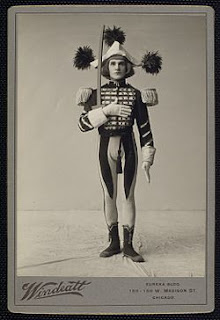
 
William Norris as a "toy soldier", 1903
      Babes in Toyland was a operetta composed by Victor Herbert with a libretto by Glen MacDonough (1870–1924), which wove together various characters from Mother Goose nursery rhymes into a Christmas-themed musical extravaganza. The creators wanted to cash in on the extraordinary success of the stage musical The Wizard of Oz, which was produced in New York beginning in January 1903, under producer Fred R. Hamlin, and directed by Julian P. Mitchell. MacDonough had helped Mitchell with revisions to the Oz libretto by L. Frank Baum. Babes in Toyland features some of Herbert's most famous songs–among them "Toyland", "March of the Toys", "Go To Sleep, Slumber Deep", and "I Can't Do The Sum". The theme song "Toyland" and "March of the Toys" occasionally show up on Christmas compilations.  
      The original production opened at the Chicago Grand Opera house in June 1903, produced by Hamlin and directed by Mitchell, and toured to East Coast cities before opening in New York on October 13, 1903 and ran for 192 performances. This was followed by many successful tours and revivals. The piece was so popular that it spawned other "fairy-tale" shows over the next decade.

What Others Like to Eat at Christmastide
      Spain loves her turkeys, Nor does she find it necessary to run them to death on the farms in order to make their meat tender, for the fowls are driven into town from long distances, and their feet are tarred to withstand the hardness of the roads. For three days before Noche Buena the streets of the cities and villages are thick with squawking poultry and bleating lambs and kids that are destined for the slaughter.
      Cuba fattens up her turkeys on walnuts to make their flesh more toothsome. Mexico grinds the cooked turkey to a paste, which is mixed with chili, raisins, currants, wine and a few other ingredients into what is called mole de guajalote. France, too, although she shows her partiality for turkeys by cramming them with truffles, coquettes with her Christmas menu. Now she throws her scarf to blood red sausage, fat and juicy; now to stewed hare with unfermented wine; again to pheasants, to hazen hens, to heath cocks.
      In Brittany the home cured ham gives savor to the rye bread and to the chocolate porridge, especially dedicated to Noel. In Cuba baked hams, preciously boiled in champagne and well sugared, vie for favor with a Spanish piece de resistance called "Mors and Christians," in reminiscence of a page in Spanish history, and made of black beans and rice.
      In southern Italy eels, curled round with tail in mouth, defy time on the Christmas board by the emblem of eternity. In the smaller Italian cities on the day before Christmas the air is shrill and cries of kids being brought to market in panniers swung from donkey backs. Chickens, pigeons, tripe, boiling hot, are other dainties appropriate to the season, as well as turkeys, geese and calf's head.
      German and Scandinavian countries are noted for the bounty of their Christmas cheer. In rural neighborhoods the tables are spread from Christmas to Epiphany. England, too, offers wide and varied hospitality. In Warwickshire, for instance, they serve roast crab apples with fresh pork and elder wine. Yorkshire has its frumenty, its Yule cakes and plum pudding. Scotland boasts one with all her own-- haddock, stuffed with oatmeal and onions. Chicago Tribune.

Christmas Night
 ***
Sometimes I think Christmas night's the 
best.
Before the nursery fire, when we're un
dressed
And all the toys are put away, except
Perhaps my engine and the baby's bear.
Then mother comes away from all the
rest
Downstairs to tell our Christmas story
there.

She takes the baby on her lap and we
Sit 'round her on the hearth-rug so we
see
The pictures in the fire, and then she
tells
About how shepherds watched their
flocks by night
And what the angels said, and how the 
three 
Wise kings came riding--and the big
star's light.

And then she tells us how it showed the
way
To just a stable where the oxen stay.
And there they found Him in His
mother's arms.
A little baby Christ-Child-and he
smiled;
And that (she says) is what made Christ-
mas day
For you and me and every little child.
Before the nursery fire when we're un-
dressed
Sometimes I think that Christmas night's 
the best.  

Christmas Advertising From J. C. Penny in 1917
      James Cash Penney began his career in retail management when he opened The Golden Rule store, a partnership with Guy Johnson and Thomas Callahan, on April 14, 1902 in Kemmerer, Wyoming. He participated in the creation of two more stores, and purchased full interest in all three locations when Callahan and Johnson dissolved their partnership in 1907. In 1909, Penney moved his company headquarters to Salt Lake City, Utah to be closer to banks and railroads. By 1912, Penney had 34 stores in the Rocky Mountain States. In 1913, all stores were consolidated under the J.C. Penney banner. The so-called "mother store", in Kemmerer, opened as the chain's second location in 1904. It still operates, as of 2011, albeit with hours shorter than many of its other store locations.
       In 1913, the company was incorporated under the new name, J. C. Penney Company, with William Henry McManus as a co-founder. In 1914, the headquarters was moved to New York City to simplify the buying, financing, and transportation of goods. Around this time, Bert J. Niver joined the company as a junior partner. By 1917, the company operated 175 stores in 22 states in the United States.
Gift suggestions for women in 1917
Gift suggestions for men in 1917.

Popular Christmas Dolls in 1917


      Carl and Pat along with Gretchen and Hortense, are making eyes at us this Christmas, inviting us to inquire into their merits. They belong to a new order of the beloved rag dolls that have always held the warmest corner of little folk's hearts. 
      These dolls are made of discarded socks or stockings and stuffed with cotton. White socks are used for the heads and colored ones for the bodies. Fancy stitching with heavy mercerized cotton or yarns, outlines the jackets, makes ties and garters and represents buttons. The eyes, nose and mouth are outlined also in black and red.

Craft An Old-World, Cotton Batting Santa

My versions of cotton batting Santas are dyed with tea.
      European artisans created ornaments from a process of spinning cotton, in forms of fruit and vegetables, and sometimes animals and people. Cotton batting ornaments are similar, which were also made in the Lauscha region. These were made from sheets of cotton batting, wrapped around a wire frame and hand painted. Often animal or human figures, these could also be dressed up in miniature items of clothing
      I made these cotton batting Santas, Belsnickels,  many years ago with very similar techniques used in the video below. I used little clay faces, though, instead of scrap ones. The Belsnickel is the forerunner of Santa Claus, a fur-clad and raggedy Christmas gift bringer who beats the children when they are not good. Antique & vintage figures depicting him are popular collectibles, particularly when they possess rabbit-fur beards and other original features. I added rabbit fur, bottle brush trees, old beads, and brown velvet to my versions to make them look similar to those that I had seen in antique shops.
      Victorians made Christmas ornaments such as these based upon patterns distributed through ladies magazines.  Victorian publishers also provided the instructions for multiple variations of cotton batting figures which proved popular across England, Europe and America. These were made in all sorts of shapes and designs, with all manner of materials, and often present a truly unique piece created not for sale, but by a family for their own tree.
"I used little clay faces, though, instead of scrap ones."
      The key interest in antique & vintage Christmas ornaments is that they are hand-made. Whether this was in a home, as part of a town’s cottage industry, or even mass manufactured, as long as the item was crafted by hand and not by machine, it is considered worthy of inclusion among these charming collectibles.
      You will find them in antique stores, at yard sales, in thrift stores, at flea markets, and on eBay. If you’re lucky, you may discover a hidden cache in your grandparents’ or parents’ attic.
      You can ascertain an antique or vintage item in a number of ways. Earlier ornaments are smaller than those of today. They are usually decorated in soft colors, with hand painted detail. Hand paint can be verified, so learn to spot it. The more examples you see, the more recognizable you will find it. The paint can often be faded or distressed. Hand blown glass items have an uneven base beneath the cap, while machine made are even. Older companies often marked their names on the item, whereas new cheap examples do not have this.
      Despite the fact that many items are becoming rarer and more expensive, there are still many many options for collectors on a budget. Prices vary from $1-$12,000 depending on the ornament, condition, and who is selling it. There are a myriad of options, and as always, buy what you admire. 
Antique cotton vegetables and fruits made for the Christmas tree.

Cotton Batting Ornaments: Step-by-Step Directions/Tutorials:
  1. DIY Cotton Batting Corn On The Cob Ornament
  2. A Craft Tutorial for a Cotton Batting Squirrel
  3. A Craft Tutorial for a Cotton Batting Hornet's Nest
  4. Wrap a Cotton Batting Christmas Bell
  5. Craft a spun cotton batting mushroom by hand
  6. DIY cotton batting cup of cocoa tutorial 
  7. A Craft Tutorial for a Cotton Batting Snowman 
  8. Craft a Cotton Batting Snow Baby
  9. Bend and Twist a Cotton Batting Birdcage 
  10. Cotton batting angel from Katty's Cosy Cove 
  11. Craft a Pear From Spun Cotton Batting 
  12. Sculpt a Cotton Batting Deer
  13. Pierrot Cotton Batting Figure 
  14. Bend a Wire Tree for a Miniature Ornament Collection: cotton batting tree 
  15. Simple Cotton Batting Acorn Ornaments 
  16. Cotton Batting Pumpkins (hollow) 
  17. How to Craft Cotton Batting Yule Log Ornaments 
  18. DIY Sea Shell Star Ornament
  19. Victorian Snowball Garland Tutorial
  20. Make This Spun Cotton Antique Looking Wreath 
  21. Craft Your Own Set of Spun Cotton Icicles 
  22. Craft a Pea Pod from Cotton Balls 
  23. Cover a wire frame basket with cotton batting 
  24. Handcrafted, Cotton Batting, Faux Candles
  25. Capturing the veiled lady in cotton...  
  26. Craft Raspberries from Cotton Batting 
  27. DIY the Prophet Jonah and Whale  
  28. DIY a cotton batting spider and web 
More Examples of Cotton Batting Santas & Figures:
How to dye textile materials to craft with: 
Scrap faces and tiny ornamental details:
This video shows a demonstration of the cotton batting Santa craft, step-by-step
by Lucy Webber.

Wednesday, December 19, 2012

A Touching Dutch Christmas Custom

Song, "Bright Star of Bethlehem."

In Holland a touching custom exists. On the night before Christmas, in commemoration of the star of the east, the young men of the town assemble and carry through the dark streets a large bright star. All the people go out to the greet it and give to the bearers of the "star of Bethlehem," as it is called, alms for the poor.

More About Dutch Christmas Traditions:

Christmas For The Birds

The Bird's Plea
***
Dear kiddies, Christmas will soon
be here.
The happiest time of all the year,
While you are enjoying your
Christmas toys
And you little hearts filled with
Christmas joys,
Please think of the wee birds out
in the snow,
Where cruel winds whistle and
fiercely blow.
Our home is the air, our roof is
the sky,
When we've nothing to eat we 
freeze and die.
Dear kiddies, you live in houses
so warm,
Sheltered from cold and the blind-
ing storm. 
You'll have "Merry Christmas"
and plenty to eat.
Oh, please give your little bird
friends a treat!
We're so hungry. Dear little kid-
dies, please
Hang us some Christmas out on
the trees. 


What are the best bird foods to put out for birds during the cold Winter weather? by Haith's Bird Food.

 
A house made using edible decorations.
       You can feed the birds by decorating a little gingerbread house with seeds, beans, pees, cranberries, orange slices and peanut butter. If you don't have someone to cut the gingerbread into a house, use graham crackers to build this instead. Here you can see the little house built by children from our home. It is has decorations glued to the surface of a cookie house using peanut butter. The birds love festive treats for Christmas just like you and I! But, you should use trimmings that are edible for them instead of candy...

More About Natural Materials:

Monday, December 17, 2012

Popular Toys for Christmas in 1962: "Pick The Present Here For A Fun-Filled Future"

The kids are in show biz the minute they unwrap this Old Mississippi showboat. It has stage scenery, cutain, cut-out characters, and the script of four plays in big, easy-to-read type. Everyone gets into the act! by Remco.
Children get a great kick out of watching things grow. A "Little Garden" electric greenhouse comes with a supply of seeds, growning medium, trays, implements, and an instruction book. by Westinghouse Electric Corporation.
Youngsters with inquiring minds will be stimulated by Add-Venture kits. One of a series, the Lite-Writer introduces the magical world of phosphorescence. Special constellation cards encourage study of the stars. by General Electric.
The simplest gifts are greeted with the most gleeful gurgles from the tiny tots. A barn full of unbreakable farm animals in fantastic colors fit into stalls matching their own shapes. Safe and washable. Lakeside Toys.
Model motor racing provides thrills for all ages. Different track layouts can be assembled and racing of the miniature cars takes real skill and co-ordination. Buildings, new cars, and equipment can be added over a long period of time. Scalextric by The Lionel Corporation.

These toys have the approval of the Toy Guidance Council. (Mentioned here as well.)

The History of Candles

        "It is time to light the Christmas candles. Light them, you and you, and let them burn with clear joyous flame. Big candles and little, colored candles and plain, let each be blazing! The little candles must give all the light they can, and the big candles all the light they will, for there can never be too much radiance on Christmas Eve or Christmas morning. Bring out the half-burned last year's candles, too, even though the memory of last year calls tears into the eyes for this is the day of such joy as shall change sorrow into peace. Bring out all the candles! The room may be bare or sumptuous. The gifts may have been chosen with painful thought and paid for with hoarded pennies; or they may have been purchased lavishly, and more from habit than from love. But never mind now: they shall all be sacred and beautiful in the gleam of the Christmas candles. Has the gospel story first been read, and, if children were not too little and too impatient, Milton's "Ode on the Nativity?" If so, then light the candles! There is no other Christmas tree quite so fine as a fir balsam, itself shaped like a tapering flame and redolent as incense. But any tree will serve, or for that matter no tree at all, for the real Christmas candles, surely, are the CANDLES IN THE HEART." Perry

In 1962, Christmas candles came in every shape and color to light your holiday home. (photos included)
1. Tall Round, 12" by Flair Candles. 2. Zarape Pillar, 6", by Clare Candles.  3. Bird in Flight, 13", by Flair.  4. Pottery Shape, 9", by Flair. 5. Party Pagoda, 7", by Flair. 6. Dinner Tapers, 15", by Paragon.  7. Party Ball, 4 1/2" diam., by Flair.   8. Giant Folding Prism, 15", by Paragon. 9. Marble Prism, 10", by Paragon 10. Flower Tapers, 15", by Paragon. 11. Vertagrain Pinnacle Prism, 10", by Paragon. 12. Chessman, 18", by Flair.  13. Rainbow Drip, 12", by Flair.  14. Royal Cierge, ribbed and plain, 14" and 10", by Bee Industries.

15. Sun, 12", by Flair. 16. Baroque, 12", by Paragon. 17. Spool, 12", by Flair. 18. Spindle, 15", by Flair. 19. Vertico Stripe Rectangles, 12" and 6", by Flair. 20. Obelisk, 15", Party Bazaar-Dennisons.  21. Left, right, Plantation, 4 3/4" and 3"; center, Cathedral, 6", by Carolina Soap and Candle Makers.  22. Glowing Prixm, 10"and 15", by Paragon.  23. Colossal Royal Queen, 20", by Bee Industries.  24. Zarape Tapers, 15", by Clare. 25. Drop, 4", imported by Svend Jensen of Denmark.  26. Square Taper, 10", imported by Svend Jenson of Denmark.  27. Classic Marble Obelisk, 15", by Paragon.
 
       The earliest known candles originated in China around 200 BC, and were made from whale fat. Candles did not appear in Europe or the Middle East until sometime after AD 400, due largely to the availability of olive oil for burning in lamps. The early European candle was made from various forms of natural fat, tallow, and wax. In the 18th century, spermaceti, oil produced by the sperm whale, was used to produce a superior candle. Late in the 18th century, colza oil and rapeseed oil came into use as much cheaper substitutes.
      Paraffin was first distilled in 1830, and revolutionized candle-making, as it was an inexpensive material which produced a high-quality, odorless candle that burned reasonably cleanly. The industry was devastated soon after, however, by the distillation of kerosene (confusingly also called paraffin oil or just paraffin). Recently resin based candles that are freestanding and transparent have been developed, with the claim that they burn longer than traditional paraffin candles. They are usually scented and oil based.
      In the Middle Ages in Europe, tallow candles were the most common candle. By the 13th century, candle making had become a guild craft in England and France. The candle makers (chandlers) went from house to house making candles from the kitchen fats saved for that purpose, or made and sold their own candles from small candle shops.
      Before the invention of electric lighting, candles and oil lamps were commonly used for illumination. In areas without electricity, they are still used routinely. Until the 20th century, candles were more common in northern Europe. In southern Europe and the Mediterranean, oil lamps predominated. In the developed world today, candles are used mainly for their aesthetic value and scent, particularly to set a soft, warm, or romantic ambiance, for emergency lighting during electrical power failures, and for religious or ritual purposes. Scented candles are used in aromatherapy.
How to turn an orange into a candle for your Christmas table.

Sunday, December 9, 2012

Christmas Among The Wealthy Kiddies


      Christmas in Millionaire row! Is it a day spent in fairyland, where one has but to wish and all sorts of lovely things come tumbling down from somewhere?
      Does Santa Claus come decked in gold and diamonds when he dashes over the roof tops as the little children of the rich he softly cradled in their beds? Not a bit of it. Santa is the same jolly old saint when he drops down the chimneys of Fifth avenue, New York, as when he leaves a toy on the ash strewn hearths of the east side. He knows that, although the big nurseries and playrooms of the avenue already hold stacks of toys and beautiful things, somehow when the flavor of fir and holly is in the air there is the same thrill in the hearts of the tots in fur and velvet as in those in cotton. And blessed old Santa smiles on both!
      To all youngsters, rich or poor-yes, and old or young-he is the embodiment of the blessed Yuletide spirit which brightens the entire year.

Exodus 22:21
"You must not mistreat or oppress foreigners in any way. Remember, you yourselves were once foreigners in the land of Egypt."

Leviticus 19:10

"It is the same with your grape crop—do not strip every last bunch of grapes from the vines, and do not pick up the grapes that fall to the ground. Leave them for the poor and the foreigners living among you. I am the Lord your God."

1 Samuel 2:8

"He lifts the poor from the dust and the needy from the garbage dump. He sets them among princes, placing them in seats of honor."

Job 31:16-23

"Have I refused to help the poor, or crushed the hopes of widows? Have I been stingy with my food and refused to share it with orphans? No, from childhood I have cared for orphans like a father, and all my life I have cared for widows. Whenever I saw the homeless without clothes and the needy with nothing to wear, did they not praise me for providing wool clothing to keep them warm? If I raised my hand against an orphan, knowing the judges would take my side, then let my shoulder be wrenched out of place! Let my arm be torn from its socket! That would be better than facing God's judgment. For if the majesty of God opposes me, what hope is there?"

Psalm 12:5

"I have seen violence done to the helpless, and I have heard the groans of the poor. Now I will rise up to rescue them, as they have longed for me to do."

Proverbs 22:22

"Don't rob the poor just because you can, or exploit the needy in court."

Romans 15:26

"For you see, the believers in Macedonia and Achaia have eagerly taken up an offering for the poor among the believers in Jerusalem."

Wednesday, December 5, 2012

Craft Baby Jesus in A Walnut Shell

The walnut split in half and spray painted gold.
      There are a number of scenarios to keep in mind when one is considering the use of an unfamiliar material in a craft project. I hope to clear a few of these up for those students who craft frequently and who also are of the mind that one's craft can potentially lead to a small but necessary profit. How does she manage to crack walnuts into perfect halves you may ask? For if you have ever attempted to do so by means of a common nut cracker, you will indeed discover that this is impossible. 
      Walnuts, as you will soon discover, are not exactly cheap and one can hardly afford to crack dozens and have only a very few of those shells be cracked exactly in half. When crafting with walnuts, always select an English Walnut not a Black Walnut. No matter how superior in flavor the Black Walnut is, it is still not the walnut that is easiest to craft with. Even though the skins of Black Walnuts do make beautiful dyes for textiles, one must avoid them altogether if you should need to crack them perfectly; the English Walnut is by far the superior prospect. Fortunately for crafters, English Walnuts are the most commonly sold in grocery stores across North America, so students will have little difficulty in acquiring these for the project below.
      As you can see from the picture above, I have split the English Walnut perfectly. As implied from the photo, it was done with the aid of a single sided razor blade. Use a hammer and a wooden chopping block to split the walnut into two perfect halves as well. This part of the process must be done by an adult.
Glue the ribbons into place prior to adding
the clay figurine.
  1. Make sure your walnut is clean and dry.
  2. Place the walnut in the center of a thick wooden chopping block.
  3. Firmly position, by hand, the sharp end of a single sided razor blade into the natural seam or crevasse of the walnut shell.
  4. Tap lightly the wrapped dull edge of the razor with a hammer until you are certain that the sharp side of the razor is fixed into the walnut's seam firmly and will not slip out during the process.
  5. Then carefully hammer the blade down into the shell with a few downward strokes of the hammer.
  6. You will find that this technique gets easier as you become familiar with it. However, be cautious, you can seriously injure yourself with the razor blade or hammer
  7. Be sensible to use a clean razor for the project if you intend to eat the walnut meat. And by clean, I mean "never been used previously" for any other purpose before, just to be on the safe side of things. When in doubt, don't eat the walnut meat; feed it to the birds.
      After splitting your walnuts in two, make sure the outside surfaces are clean and smooth and the inside walnut meat is completely removed. Then you can line up the nut shells, smooth side up on top of newspapers and spray paint these with your choice of metallic gold or silver spray paint. As with most Chrismons, the colors of choice are traditionally gold and white, I have sprayed my versions shown above and below with gold paint.
      The next step in the assembly is to glue down the ribbons of the walnut ornament used to create the hanger. Sandwich the ribbon, wire, or gold thread (whatever you are using) between the clay and the shell of the walnut. Make sure that the hanger has been secured with glue to the shell prior to  adhering the air-dry clay figurine of the baby Jesus. This step will give the ornament a professional  appearance. (Pictured right and above.)
The baby Jesus in a walnut shell Chrismon. This particular one is made with a molded baby laying in a bed of straw. The molded piece is made with air-dry clay and is glued in place with tacky glue and then left over night to dry. I then painted it with acrylic paints and varnished it with Mod Podge. The halo was painted with gold glitter glue.
      The baby Jesus may be made either from a homemade press mold or push mold (see video here) , a purchased mold or from a tiny prefabricated baby or even a small wooden dowel. This part of the craft project will be completed according to the supplies that are available. I have linked to a wide variety of examples of the ornament below. 
      This traditional Christmas ornament craft may be turned into a Chrismon by using a gold and white color scheme and by teaching little ones the importance of celebrating the baby Jesus' birth found in the Bible, Luke Chapter 2, during the month of December.


More Versions of Baby Jesus in a Walnut Shell:
Entire Nativities in Walnut Shells!:

Tuesday, December 4, 2012

Porcelain Cup Cake Sampler

I finished painting my porcelain cup cakes for the St. Louis Lutheran South Craft Fair early this morning. This one is chocolate cake with strawberry icing topped with a whole strawberry and sprinkled with extra chocolate chips.
      These are adult made versions of a student ceramic lesson plan that I 've posted at my Art Education Daily Blog.  Learn how to make these cup cakes; click here.
These ceramic baked goods include caramel and fudge swirls, cherries, strawberries and pink icing.