Showing posts sorted by relevance for query angels. Sort by date Show all posts

Wednesday, November 20, 2013

Black and White Clip Art of Angels

Angel pointing to a star
Angels with The Ten Commandments
Angels deliver a soul to Heaven
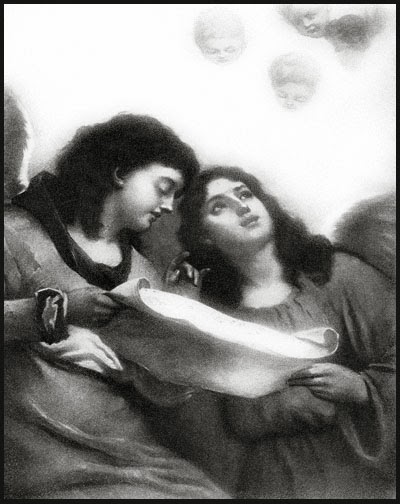
Angels sing about God's glory
A group of lively angels toll the bells in a church
An angel visits a weary mother
Angels with laurels
Attending Angels carry a soul to Heaven
Angels deliver another soul to Heaven

More Clip Art of Angels:
Coloring Pages of Angels:

Sunday, December 14, 2014

Ornaments Made from Angel Cross Stitch Patterns

By Prairie School and perfectly lovely addition,
I think, to a Medieval Christmas Tree.

        These little cross stitch angel patterns, created 1993, were based upon Byzantine designs. They were also intended to be produced on black canvas backgrounds. Several years ago my oldest child stitched a couple of these unusual angelic motifs for our family Christmas tree. 
Michael and Gabriel, two archangels
        The Prairie School patterns depict angels in brilliant colors, formally positioned wings and with iconographic portrait features. I've included a sample of Byzantine angels in this post so that you may make your own comparisons.
       During the medieval period senior angels were often clad in every brilliant color, while junior ranks wore white by artists. Early Renaissance painters such as Jan van Eyck and Fra Angelico painted angels with multicolored wings. Depictions of angels came to combine medieval notions of beauty with feminine ideals of grace and beauty, as in da Panicale's 1435 Baptism of Christ.
      The two angels on the right were painted in a 12th Century icon. They are the two archangels, Michael and Gabriel. They wear the loros of the Imperial guards. The loros is one of the most important and distinctive parts of the most formal and ceremonial type of imperial Byzantine costume. It developed out of the trabea triumphalis of the Roman consuls. The loros was a long, narrow and embroidered scarf which was wrapped around the torso and dropped over the left hand. It was embroidered with gold and heavily embellished with gems.
       You can search online to find a wider variety of angels dating from the Medieval Period, 5th century to the 15th, in order to design your own ornaments. Ebay sometimes offers old Prairie School patterns for sale as well.

View and Read About Different Angel Types from The Medieval Period:

Thursday, December 8, 2022

Angels from The Realms of Glory

       "Angels from the Realms of Glory" is a Christmas carol written by Scottish poet James Montgomery.  It was first printed in the Sheffield Iris on Christmas Eve 1816, though it only began to be sung in churches after its 1825 reprinting in the Montgomery collection The Christian Psalmist and in the Religious Tract Society's The Christmas Box or New Year's Gift.
       Before 1928, the hymn was sung to a variety of tunes, including "Regent Square" by Henry Smart, "Lewes" by John Randall, and "Wildersmouth" or "Feniton Court" by Edward Hopkins.  In the United States, "Regent Square" is the most common tune.  In the United Kingdom, however, the hymn came to be sung to the French carol tune "Iris"  (Les anges dans nos campagnes, the tune used for "Angels We Have Heard on High") after this setting was published in the Oxford Book of Carols. Sometimes the "Gloria in excelsis Deo" refrain is even sung in place of Montgomery's original lyric: "Come and worship Christ the new-born King".
       The name for the "Regent Square" tune is reportedly an association with the publisher of the first hymnal to contain it, James Hamilton, who was the minister of the Regent Square Church situated in London.

More Versions of "Angels from The Realms of Glory:

 
Lyrics for Angels from The realms of Glory

Angels, from the realms of glory,
Wing your flight o'er all the earth;
Ye who sang creation's story,
Now proclaim Messiah's birth:

Refrain: Come and worship,
Come and worship
Worship Christ, the newborn King.

Shepherds, in the fields abiding,
Watching o'er your flocks by night,
God with man is now residing,
Yonder shines the infant light:

Refrain.

Sages, leave your contemplations,
Brighter visions beam afar;
Seek the great Desire of nations,
Ye have seen his natal star:

Refrain.

Saints before the altar bending,
Watching long in hope and fear,
Suddenly the Lord, descending,
In his temple shall appear.

Refrain.

Sinners, wrung with true repentance,
Doomed for guilt to endless pains,
Justice now revokes the sentence,
Mercy calls you—break your chains:

Refrain.

Though an infant now we view him,
He shall fill his Father's throne,
Gather all the nations to him;
Every knee shall then bow down:

Refrain.

All creation, join in praising
God the Father, Spirit, Son,
Evermore your voices raising,
To th'eternal Three in One:

Refrain.

Saturday, November 29, 2014

A Quilted Colonial American Christmas Angel Ornament

Left, you can see the store bought, angel stamp that I purchased for the ornament project. Right, the finished quilted Colonial American Christmas Angel ornament, trimmed in white eyelet lace.
       I made these foam stamped angel ornaments several years ago for family and friends. Although I purchased this little Colonial American angel stamp ahead of time, crafters may decide to manufacture their own versions by using a die cut stamp making technique. I've included a video below by Michelle Joy Wecksler that shows how to make these.
      You don't really need fancy inks or paints to stamp nice images onto cotton fabric; I used ordinary acrylic, red, paint for my stamped ornament version above. I backed the printed fabric with a layer of cotton batting plus an additional cotton backing using the same muslin. Then I quilted the three layers together. I followed the outline of the angel with my needle and quilter's thread until I reached the oval's edge of the muslin medallion. Then I repeated the same process for the backside of the ornament. 
       Choose the nicest of the two quilted medallions for the front of your ornament. Sew with a straight stitch around the edge of the medallion perimeter a piece of white eyelet lace. Turn this lace to the inside of the medallion's center and sew the back medallion piece face down on top of the front side, leaving a one inch opening for stuffing. Turn the oval medallion inside out and stuff it with a soft cotton batting. 
      Turn under the one inch opening with your needle as you close up the opening you used to stuff your ornament with a whip stitch. Clean up the puckered edges using a slip stitch with additional quilter's thread.
      Cut a simple white ribbon and tack this onto the outside of your cotton muslin medallion using quilter's thread.
I printed my Colonial American angel on top of white cotton, using a red acrylic paint that I purchased from my local hobby store. Right, you can see a detailed shot of the quilted stitches up close.
 Make your own die cut foam stamps.

      I've included examples of angels below that can be found carved into Early Colonial American tombstones. Sometimes similar primitive angels can by found in Pennsylvania Dutch frakturs. However, not all angels were illustrate so primitively on those manuscripts. Some folk artists preferred naive looking angels and others preferred angels that looked more realistic. Frakturs drawn during the Colonial American era depict both styles because they were produced by artists of various degrees of talent and/or taste. Personally, I prefer the primitive fraktur and tombstone angel designs.

Winged skull & winged soul effigies on Phebe (1757) and Timothy Peck
 (1790) gravestones, Morristown, NJ
Granite tombstone of Josiah Leavitt (1679–1717), Hingham Center
 Cemetery, Hingham, Plymouth County, Massachusetts
Captain Andrew Drake (1684–1743) sandstone tombstone from 
the Stelton Baptist Church Edison, New Jersey
See More Early American Tombstones Depicting Angels:

Friday, December 8, 2023

Craft Vintage Inspired Cone Figures

Finished vintage inspired, cone angel figures.
       Tiny cone figures were frequently produced by mass industry at the end of the 1940s, primarily by the Japanese or in Germany for the North American market place. Catalogue companies like: J. C. Penny, Wards and Sears sold cone figures by the thousands through the mail, while five-and-dime stores like Woolworth's and made small fortunes by supplying the same kinds of factory made, inexpensive holiday ornaments directly from store displays and shelves.
      My vintage inspired angels are made the old-fashioned way, by hand. Factory made ornaments became popular after the first and second World Wars. Prior to that time, most ornaments were either made at home or supplied by various cottage industries throughout Western Europe and The United States, wherever Christmas trees were most popular. I've posted some examples of these manufactured angles below.
       To make cone shaped angels, your will need the following supplies: cotton batting balls (for heads), decorative papers (tiny Christmas designs), scrap cardboard, trim for bottom of skirts (lace and rick-rack), acrylic paints for heads and arms, thin wire for arms, tiny novelties for angels to hold (see pictures), white glue and hot glue.

Step-by-Step Instructions:
  1. Roll heads from cotton batting and white glue. 
  2. Cut out skirts from patterned Christmas papers. 
  3. Shape and paste the paper skirts into cones. 
  4. Glue the head on top. 
  5. Stuff the cone shaped skirts with acrylic batting. 
  6. Glue a cardboard disk to the bottom of the cones.
  7. Glue the pom pom features to the top of the head(s), one or two.
  8. Wrap the string around the pom poms and above the forehead areas to make the hair design.
  9. Cut the wings from decorative papers and glue these on.
  10. Wrap cotton batting around thin wire and let dry.
  11. Cut small pieces of that wire for arms and attach these with hot glue.
  12. Hot glue tiny gifts for angels to carry: holly and berries, bows for presents, snowflakes, bottle brush trees etc...
  13. Smear on touches of white glue and sprinkle angle wings with glitter.
      Left, roll heads from cotton batting and white glue. Center, cut out skirts from patterned Christmas papers. Right, shape and paste the paper skirts into cones, glue the head on top. I stuff the cone shaped skirts with acrylic batting and glue a cardboard disk to the bottom of the cones.
Left, tiny cone angels hold: holly, bow and snowflake. Center several have bottle brush
 trees. Right, one has wings cut from a doily... and many have transparent glitter stuck
  to their wings.
Left, my tiny vintage cone angel ornaments. I hang these on my feather tree every Christmas. Right, old catalogue page shown. Elf-like figures. Pine-cone dwarfs, Santas, angels, snowmen. Cotton felt. Stand or hang from tree. Set of 15. From Japan. Shipping weight 12 oz.  
Close up of a tiny vintage cone angle from the 1960s. This tiny angel has a metallic paper skirt and embossed gold wings. She carries two candles in her small chenille stem armature. Her head is made from cotton batting. She has a beaded collar and hair made from tinsel.
Close up of a tiny pink vintage cone angel from the 1960s. Her dress is made from painted pink cardboard sprinkled with silver glitter. She has white chenille stem arms and holds a tiny sprig of green to represent a tree. Her wings are embossed and pink, her head is a cotton batting ball and her yellow hair is made from a silky strand of yarn.

Left, are miniature angels with tulle skirts playing harps. Right the very same hold lights, seen in catalogue.

Pattern for making a cone angel and one version of wings.
Go here to see a craft of a praying angel wreath for older students.

More Examples of Vintage Figures from The 1960s:

Saturday, May 2, 2009

Hark! The Herald Angels Sing.

      "Many popular Christmas hymns have a most interesting history. Those who have heard the waits and carolers sing "Hark, the Herold Angels Sing!" on Christmas eve will be astonished to know that many years ago it was rendered "Hark, How All The Welkin Rings!" and was sung to the tune of "See the Conquering Hero Comes." When this former wording was adopted in the new hymn book of the "Hymns Ancient and Modern" there was a great storm of criticism from those who prefer the modern version. The hymn was written by Charles Wesley." from How We Got Our Christmas Hymns, 1913
 
Vintage sheet music of "Hark the Herald Angels Sing", CC.
       In 1721, a wealthy Irishman offered to adopt Charles Wesley and make him his legal heir. The thirteen year old boy refused the offer, choosing to continue his way through school under very trying circumstances. This turned out to be one of the most momentous decisions of his life. The boy who was adopted in place of Charles became an earl, and grandfather of the famous Duke of Wellington, while the young Wesley achieved immortal fame through his hymns. He is often called "The Prince of Hymn Writers".
       Charles Wesley and his older brother, John (founder of the Methodist Church) made a brief visit to America in 1735. The two brothers came to Georgia as secretaries to General Oglethorpe. They returned to England the following year. It is said that Charles became interested in hymns on hearing a group of German Moravians singing their hymns aboard ship.
       Wesley is said to have written over six thousand hymns and spiritual songs. His two greatest hymns are: Jesus Lover of My Soul (1740) and Hark! The Herald Angels Sing (1739). The latter, in its original form, opened with the lines "Hark how all the welkin rings. Glory to the King of Kings!" Through the course of time, various revisions have been made.
       It is a curious fact that the Mendelssohn melody, which is so admirably suited to the song, is an adaptation. In 1840, Felix Mendelssohn composed a cantata to commemorate the invention of printing. This cantata, called "Festgesang" (Festival Song), was presented at the great festival held at Leipzig. Fifteen years later (1855), Dr. W. H. Cummings, organist at Waltham Abbey, England, adapted the melody of the second chorus of Mendelssohn's cantata to Wesley's Christmas hymn. He arranged it for his choir and presented it on Christmas day. The new melody was so well received that it was published the following year and soon became the accepted version of the hymn.
       Mendelssohn was not completely satisfied with the original words to this melody in the Festgesang. He thought it ought to have other words — but not sacred words. This is verified by a very definite statement which he made in a letter to his publishers in England concerning a possible English translation. Quotations from this letter were published in 1933, by Dr. Dearmer, in his Songs of Praise.
       Had Mendelssohn lived to hear his melody sung to the sacred words of Hark! The Herald Angels Sing, we wonder if it would not have won his enthusiastic acclaim, as it has won the acclaim of millions throughout all Christendom. Kvamme.


Tuesday, November 4, 2014

Make a Pasta Angel Ornament

Three views of my pasta angel.
Supply List:
  • Bow Tie Pasta
  • Macaroni Pasta
  • Thumbtacks
  • tiny wooden beads
  • Rigatoni Pasta
  • Minute Pasta or White Rice
  • Hot glue gun
  • white spray paint
  • decorative ribbon for the hanger
  • wax paper or tin foil
  • medium sized cardboard box
  • paper face mask
Step-by-Step Instructions:
  • Hot glue a wooden bead to the top of a Rigatoni piece of pasta. The Rigatoni will act as the torso of the angel, the wooden bead will be her head.
  • Glue one piece of macaroni to each side of the torso to act as arms.
  • Now hot glue the inverted tack on top of the angels arms to act as the candle in a holder.
  • Next, glue on a Bow Tie pasta piece between the angel's shoulder blades on the back side of her torso; this pasta is her wings.
  • The last gluing step involves adding enough glue to the top and sides of the wooden bead to make the hair. Use some tiny shapes of Minute Pasta or white rice for this step.
  • Let the tiny Pasta figures dry and snip off any stray glue strands that are not attractive. Hot glue leaves some of these while you work.
  • Choose a warm dry place to work so that the painted pasta angels will dry quickly between coats of spray painting. Make sure that this environment is well ventilated. Read the instructions on the label of spray can carefully. Wear a disposable paper mask while you are working to limit the amount of fumes that you inhale while working.
  • Line the bottom of the box where you will be spray painting the angels with wax paper or tin foil so that the painted pasta ornaments do not stick the surface in which they are lying on as they dry. 
  • It is important to spray paint within the interior of a box so that the spray paint does not land upon other surfaces that you do not intend to paint during the process. 
  • Turn the pasta angels and spray them lightly in layers as they dry. 
  • Hot glue a fancy ribbon to the tip of the angel's head or to the back of your angel's wings.
See more versions of pasta ornaments:

Sunday, December 4, 2016

Color This Guardian Angel for Christmas

 
       I've restored this coloring page by Walter Crane for your Christmas coloring fun. You may download more restored pages by this famous illustrator at The Crayon Palace.
       I will be restoring and maintaining a collection by Crane on my children's coloring blog for the following year. 

 
 The Winter Brook by Marian Willard

Do you dream, little brook, in the long night,
'Neath your blanket of soft white snow?
Do you dream of the light of the sunshine bright,
When the nodding daisies grow?

Do you dream as you sleep 'neath the winter stars,
That the snow-drifts that o'er you sweep,
Are the spirits of flowers from the summer hours
That a guard and a watch will keep?

More Christmas Angels To Color:

Saturday, May 2, 2009

The Coming of The Prince, Part II

 Part I is here.

      "What do you see up there, O pine-tree?" asked a little vine in the forest. "You lift your head among the clouds tonight, and you tremble strangely as if you saw wondrous sights."
      "I see only the distant hill-tops and the dark clouds," answered the pine-tree. "And the wind sings of the snow-king to-night; to all my questionings he says, 'Snow, snow, snow,' till I am wearied with his refrain."
      "Oh, yes, said the vine. "I heard the country folks talking about it as they went through the forest today, and they said that the prince would surely come on the morrow."
      "What are you little folks down there talking about?" asked the pine-tree.
      "We are talking about the prince," said the vine.
      "Yes, he is to come on the morrow," said the pine-tree, "but not until the day dawns, and it is still all dark in the east.
      "Yes," said the fir-tree, "the east is black, and only the wind and the snow issue from it."
      "Keep your head out of my way!" cried the pine-tree, to the fir; "with your constant bobbing around        I can hardly see at all."
      "Take that for your bad manners," retorted the fir, slapping the pine-tree savagely with one of her longest branches.
      The pine-tree would put up with no such treatment, so he hurled his largest cone at the fir; and for a moment or two it looked as if there were going to be a serious commotion in the forest.
      "Hush!" cried the vine in a startled tone; "there is some one coming through the forest."
       The pine-tree and the fir stopped quarreling, and the snowdrop nestled closer to the vine, while the vine hugged the pine-tree very tightly. All were greatly alarmed.
      "Nonsense!" said the pine-tree, in a tone of assumed braver. "No one would venture into the forest at such an hour."
      "Indeed! and why not?" cried a child's voice. "Will you not let me watch with you for the coming of the prince?"
      "Will you not tear me from my tree?" asked the vine.
      "Will you not pluck my blossoms?" plaintively piped the snowdrop.
      "No, of course not," said Barbara; "I have come only to watch with you for the prince."
      Then Barbara told them who she was, and how cruelly she had been treated in the city, and how she longed to see the prince, who was to come on the morrow. And as she talked, the forest and all therein felt a great compassion for her.
      "Lie at my feet," said the pine-tree, "and I will protect you."
      "Nestle close to me, and I will chafe your temples and body and limbs till they are warm," said the vine.
      "Let me rest upon your cheek, and I will sing you my little songs," said the snowdrop.
And Barbara felt very grateful for all these homely kindnesses. She rested in the velvety snow at the foot of the pine-tree, and the vine chafed her body and limbs, and the little flower sang sweet songs to her.
      "Whirr-r-r, whirr-r-r!" There was that noisy wind again, but this time it was gentler than it had been in the city.
      "Here you are, my little Barbara," said the wind, in kindly tones. "I have brought you the little snowflake. I am glad you came away from the city, for the people are proud and haughty there; oh, but I will have fun with them!"
      Then, having dropped the little snowflake on Barbara's cheek, the wind whisked off to the city again. And we can imagine that it played rare pranks with the proud, haughty folk on its return; for the wind, as you know, is no respecter of persons.
      "Dear Barbara," said the snowflake, "I will watch with thee for the coming of the prince."
       And Barbara was glad, for she loved the little snowflake, that was so pure and innocent and gentle.
      "Tell us, O pine-tree," cried the vine, "what do you see in the east? Has the prince yet entered the forest?"
      "The east is full of black clouds," said the pine-tree, " and the winds that hurry to the hill-tops sing of the snow."
      "But the city is full of brightness," said the fir. "I can see the lights in the cathedral, and I can hear wondrous music about the prince and his coming."
      "Yes, they are singing of the prince in the cathedral," said Barbara sadly.
      "But, we shall see him first, "whispered the vine reassuringly.
      "Yes, the prince will come through the forest," said the little snowdrop gleefully.
      "Fear not, dear Barbara, we shall behold the prince in all his glory," cried the snowflake.
       Then all at once there was a strange hubbub in the forest; for it was midnight, and the spirits came from their hiding-places to prowl about and to disport themselves. Barbara beheld them all in great wonder and trepidation, for she had never before seen the spirits of the forest, although she had often heard of them. It was a marvelous sight.
      "Fear nothing," whispered the vine to Barbara,-- "fear nothing, for they dare not touch you."
       The antics of the wood-spirits continued but an hour; for then a cock crowed, and immediately thereat, with a wondrous scurrying, the elves and the gnomes and the other grotesque spirits sought their abiding-places in the caves and in the hollow trunks and under the loose bark of the trees. And then it was very quiet once more in the forest.
      "It is very cold," said Barbara. "My hands and feet are like ice."
      Then the pine-tree and the fir shook down the snow from their broad boughs, and the snow fell upon Barbara and covered her like a white mantle.
      "You will be warm now," said the vine, kissing Barbara's forehead. And Barbara smiled.
       Then the snowdrop sang a lullaby about the moss that loved the violet. And Barbara said, "I am going to sleep; will you wake me when the prince comes through the forest?"
       And they said they would. So Barbara fell asleep.
      "The bells in the city are ringing merrily," said the fir, " and the music in the cathedral is louder and more beautiful than before. Can it be that the prince has already come into the city?"
      "No," cried the pine-tree, " look to the east and see the Christmas day a-dawning! The prince is coming, and his pathway is through the forest!"
      The storm had ceased. Snow lay upon all the earth. The hills, the forest, the city, and the meadows were white with the robe the storm-king had thrown over them. Content with his wondrous work, the storm-king himself had fled to his far Northern home before the dawn of the Christmas day. Everything was bright and sparkling and beautiful. And most beautiful was the great hymn of praise the forest sang that Christmas morning,-- the pine-trees and the firs and the vines and the snow-flowers that sang of the prince and of his promised coming.
      "Wake up, little one," cried the vine, "for the prince is coming!"
      But Barbara slept; she did not hear the vine's soft calling nor the lofty music of the forest.
       A little snow-bird flew down from the fir-tree's bough and perched upon the vine, and caroled in Barbara's ear of the Christmas morning and of the coming of the prince. But Barbara slept; she did not hear the carol of the bird.
      "Alas!" sighed the vine, "Barbara will not awaken, and the prince is coming."
      Then the vine and the snowdrop wept, and the pine-tree and the fir were very sad.
       The prince came through the forest clad in royal raiment and wearing a golden crown. Angels came with him, and the forest sang a great hymn unto the prince, such a hymn as had never before been heard on earth. The prince came to the sleeping child and smiled upon her and called her by name.
      "Barbara, my little one," said the prince, "awaken, and come with me."
      Then Barbara opened her eyes and beheld the prince. And it seemed as if a new life had come to her, for there was warmth in her body and a flush upon her cheeks and a light in her eyes that were divine. And she was clothed no longer in rags, but in white flowing raiment; and upon the soft brown hair there was a crown like those which angels wear. And as Barbara arose and went to the prince, the little snowflake fell from her cheek upon her bosom, and forthwith became a pearl more precious than all other jewels upon earth.
      And the prince took Barbara in his arms and blessed her, and turning round about, returned with the little child unto his home, while the forest and the sky and the angels sang a wondrous song.
      The city waited for the prince, but he did not come. None knew of the glory of the forest that Christmas morning, nor of the new life that came to little Barbara.
      Come thou, dear Prince, oh, come to us this holy Christmas time! Come to the busy marts of earth, the quiet homes, the noisy streets, the humble lanes; come to us all, and with thy love touch every human heart, that we may know that love, and in its blessed peace bear charity to all mankind! by Eugene Fields.

The first half of our story.

Saturday, July 16, 2022

Christmas by Eleanor A. Hunter

Restored vintage postcard of angels with instruments and church.
 

Christmas
by Eleanor A. Hunter


The rounded hills in quiet lay;
The Shepherds watch were keeping;
Clothed in soft fleece, in warmth and peace,
Their gentle flocks were sleeping.
No sound was there in earth or air,
Through wind-swept, star-lit spaces;
O'er field and hill the wind blew chill,
And o'er the shepherds' faces.

When suddenly through parted skies
A wondrous light was beaming,
And crowds of angels filled the air
From out heaven's portals streaming;
Abroad their glorious wings they spread,
Their throats with song were swelling;
In garments bright, with looks of light
The shepherds' fears dispelling.

Ah, long ago that song was sung,
Of "Glory in the highest,
Good-will and peace to all mankind,"
When heaven to earth drew nighest,
Because that night the Lord of Light
Came down to earth a stranger,
Was born within a stable old,
Was cradled in a manger.

The brown-eyed cattle watched His sleep,
The shepherds sought and found Him,
Led by the Star that shone afar,
The wise men knelt around Him;
Spices and gold they brought of old,
With joy rich gifts left with Him;
And you have too, my golden head,
A little heart to give Him.

'Mid crash and clang of Christmas bells
That ring so loud and cheerly,
Forget not that He cam a child
Because He loved you dearly.
Give sweeter kiss, give closer clasp,
Give gentler Christmas greeting,
Remembering Him whose blessed name
It is you are repeating.

Sunday, November 18, 2018

Merry Acrostic Christmas

CHRIST'S coming inaugurated among men a new era of good will, and as a consequence thrones are tottering, chains are loosening, prison doors are opening and practical Christian beneficence is flooding the world with sunshine and fills it with songs of gladness. - Rev. Dr. P. S. Henson.
HERE is that "glad tidings," that gospel of "great joy" of which the angel spake to the wondering shepherds -- this announcement of God's love for man and man's sonship to God. And these "glad tidings" are for "all people," so the angel said. There is not a single soul to whom the tidings of Christmas come that is not assured of the love of the almighty and infinite Father.
REFORM ye, then -- so sounds the voice of the Eternal Spirit, the power back of evolution -- reform ye, for the kingdom of heaven is at hand! So we may gird ourselves to every task of reform with new hope and fresh enthusiasm and ring our Christmas bells again. - Rev. Dr. R. Herber Newton.
IT may be that in every gift, with which at this blessed Christmastide we gladden our children's hearts we are the Magi again offering treasure to the Holy Child. We may make it so. But richer gifts than these will be required. Our endurance shall be our gift to him who gave himself. Is there toil for us, that we may honor him? Is there self denial? Are there holy consecrations and humble service, that shall make the world at last a spotless sacrifice to him who purchased it?
SO we keep Christmas because of its good tidings of great joy. The season of its occurrence is our ripest time. The north wind and the snow in that wind have made us what we are. It drove us to the hearth, to the sacred fires of the inner circle, to the building of the keystone in the arch of our civilization, the home of the Christian man. - Rev. Dr. S. P. Cadman.
TODAY all institutions are beginning to imitate the wise men from the east, who brought to the Divine Child their gold and aromatic spices their frankincense and treasure. Christ's estimate of the value of childhood has conquered the world. His thought of childhood is the very heart and genius of Christian civilization. - Rev. Dr. Newell Dwight Hillis.
MORNING, noon and night, for breakfast, dinner and supper, the first thing on awaking and the last thing on going to sleep, every hour of every day of every week of every month of the year we want the spirit of Christmas, for it is the spirit of ministration, of giving, of service, of doing for others. - Rev. Dr. Francis E. Clark
AND did you ever think what a peculiarly blessed sound in the ears of those watching shepherds of the valley of Bethlehem was the announcement of the angels, "Christ has come?" Ever since the gate of paradise was shut against our first parents his advent had been looked forward to as the hope of a lost world.
STILL there is call for strenuous endeavor and constant fight against evils without and within, as though God would remind us that this is not our rest, that the true holiday (holy day, as it used to be written) is above at his right hand. - Rev. Dr. P. S. Henson.
More Encouragement:

Tuesday, November 18, 2014

DIY White Feathered Angel Ornament

       I crafted this silver and white angel from a single porcelain head, one pipe cleaner and a fistful of white downy feathers. She would look marvelous on a Victorian tree!
Supply List:
  • white feathers
  • silver beaded thread
  • silver tinsel ruffle
  • silver gems
  • silver wired ribbon
  • silver cross charm
  • small porcelain doll head/breastplate
  • one white chenille stem
  • scissors
  • hot glue gun
  • toothpicks
Step-by-Step Instructions:
  1. Cut the chenille stem in half.
  2. Position the pipe cleaner or chenille stem in the center of the wired ribbon. Then wrap the stem while hot gluing the edges of the ribbon into shape. I did not use the full length of this ribbon to wrap my stem; I only used approximately 1/3 of the ribbon. See picture below.
  3. Now bend the covered stem in half and hot glue this up inside the breastplate of the doll. There should still be plenty of room left there for you to hot glue the feathers and silver tinsel.
  4. Hot glue the silver beaded thread around the outside of the angel's breastplate. (shown below)
  5. Hot glue multiple white feathers stacked on top of one another then hot glue the silver tinsel on top of the feathers.
  6. Hot glue the stack of feathers and tinsel to the inside cavity of the porcelain doll's breastplate just beneath the chenille stem arms.
  7. Bend the arms to the front and hot glue a small charm between the angel's hands; I chose a silver cross.
  8. Finally hot glue a selection of shorter white feathers to her backside; stacking and gluing until you are satisfied with the results. It's that easy!
  9. Hot glue the silver beaded thread on top of her head to make a halo. Use the tip of a toothpick to clean away excess glue while you are working. This will greatly improve the quality of the angel's appearance.
Position the pipe cleaner or chenille stem in the center of the wired ribbon.
 Then wrap the stem while hot gluing the edges of the ribbon into shape.
 I did not use the full length of this ribbon to wrap my stem; I only used
approximately 1/3 of the ribbon.
Left, you can see that I have wrapped and hot glued some tiny silver beads around the outside
 of the breast plate of my angel. Left, here I have hot glued the ribbon wrapped chenille stem
 to the inside shell of my porcelain doll's breast plate.
An angel crafted almost entirely with white feathers.
The angel's backside.
More Angels Made with Feathers:

Tuesday, May 3, 2016

"The Cherry Tree Carol"

Lyrics. Click.
 
       "The Cherry-Tree Carol" is a ballad with the rare distinction of being both a Christmas carol and one of the Child Ballads (no. 54). The song itself is very old, reportedly sung in some form at the Feast of Corpus Christi in the early 15th century. The versions eventually collected by Francis James Child are thought to be a combination of up to three separate carols that merged through the centuries.
       The ballad, "The Cherry Tree Carol," relates an apocryphal story of the Virgin Mary, presumably while traveling to Bethlehem with Joseph for the census. In the most popular version, the two stop in a cherry orchard, and Mary asks her husband to pick cherries for her, citing her child. Joseph spitefully tells Mary to let the child's father pick her cherries.        At this point in most versions, the infant Jesus, from the womb, speaks to the tree and commands it to lower a branch down to Mary, which it does. Joseph, witnessing this miracle, immediately repents his harsh words. The more contemporary versions sometimes end here, while others often include an angel appearing to Joseph and telling him of the circumstances of Jesus's birth. Other versions then jump ahead several years, where the next verse picks up with Jesus on his mother's lap, telling her of his eventual death and resurrection. Read more...

In Defense of Joseph . . .  Angels did appear to Joseph to explain to him what was transpiring in his life and he shared this with Mary and others. So in his defense I have referenced the scripture. However, the carol is still quite lovely, however inaccurate it may be. (smile) The implications here are that Joseph actually had frequent directions from angels.

"But after he had considered this, an angel of the Lord appeared to him in a dream and said, "Joseph son of David, do not be afraid to take Mary home as your wife, because what is conceived in her is from the Holy Spirit." Matthew 1:20

"When they had gone, an angel of the Lord appeared to Joseph in a dream. "Get up," he said, "take the child and his mother and escape to Egypt. Stay there until I tell you, for Herod is going to search for the child to kill him." Matthew 2:13 


       And also the name of Joseph carries big news in scripture; any man selected by God and given the name is in for an unusual life story according to the Bible. The name literally means "to add to or give increase." 


"Judy Collins sings this traditional nativity ballad, thought to date back to the 15th century. The story tells of the fetus Jesus performing a miracle by lowering the bow of a cherry tree so that Mary can reach and pick the fruit. This clip comes from a 1996 performance at the Biltmore Estate in North Carolina, available on the 1997 DVD release titled "Judy Collins - Christmas at the Biltmore Estate." Look for more clips from the concert here on YouTube's Judy Collins Channel."

Saturday, June 14, 2014

What the Wax Angel Saw

"Come now, let us reason together, says the LORD: though your sins are like scarlet, they shall be as white as snow; though they are red like crimson, they shall become like wool." Isaiah 1:18 


"What the Wax Angel Saw: A Christmas Sermonette"
      There was once a little wax angel with golden hair and a blue silk sash, who was taken gently from her bed of cotton in the attic every year for many, many years and poised on the green spire of the great fir tree in the library. Her outstretched arms seemed always to be scattering blessings on the happy circle in the glow of the Christmas candles.
      She had looked down on the first Christmas of the wide-eyed first born; she had smiled her waxen smile at the boisterous joy of ten, the sentiments of sixteen and the worldliness of forty. Indeed, her blue glass eyes had beheld the seven stages of Yuletide rejoicing.
      Now, one day it was noticed that the beautiful blue sash of the little wax angel was faded and grimy, that her pink cheeks were pale, her nose quite flattened and her left foot gone.
      "We'll have to use something else for the tree this year," said Mother. "The little wax angel is all worn out."
      And the next day her flattened nose was buried in the rubbage heap.
      Nobody would have believed it, but the wax angel was glad her tree-top days were over. Her arms were very tired scattering blessings that were reckoned by dollars and cents; she had often wished to close her eyes on the pretenses and petty calculations of Christmas giving; she had grown pale because of her long vigil over the mockery of the Christmas spirit.
      She had seen greediness planted in young hearts by the thoughtless generosity of their doting elders. She had seen quick eyes search for hidden prize marks, and, when found, she had beheld their owner's look of chagrin or satisfaction in reflecting upon the exchange of baubles that had been made. She had heard wives and daughters and sons accept complacently enthusiastic thanks for lavish gifts--thanks which the wax angel knew were due only to the Father over there with the weary eyes and the limp purse.
      She knew, too, that the frenzied purchasing, at the last minute, of that piece of real lace for the Rich Aunt has cost not only more than could be afforded, but it had cost also all the Christmas joy--meager enough--of the salesgirl who sold it. It's fussy, irritable selection had been the last straw at the end of many tired days. After the last sale the girl at the lace counter just crumpled up and lay on her bed all of that Christmas day and other days besides.
      You see, it is given to little wax angels to see many things, hidden or unheeded by the best of us.
      Suppose you resurrect the one that may have topped the Christmas tree of your youth--or perhaps only of your fancy. Let her unblinking eyes peer into your secret soul, and note if she finds there the real Christmas spirit, or the mockery thereof, that has paled her cheek and dimmed her blue glass eyes. Or perhaps it may have been a silvery star that glistened on your tree-top. Look if it has not been tarnished by your growing indifference to the good-will and kindness and other things for which is stands.
      With a shining star, and all that it symbolizes, or an all-seeing little wax angel as your mentor, you will need no other Christmas sermon.